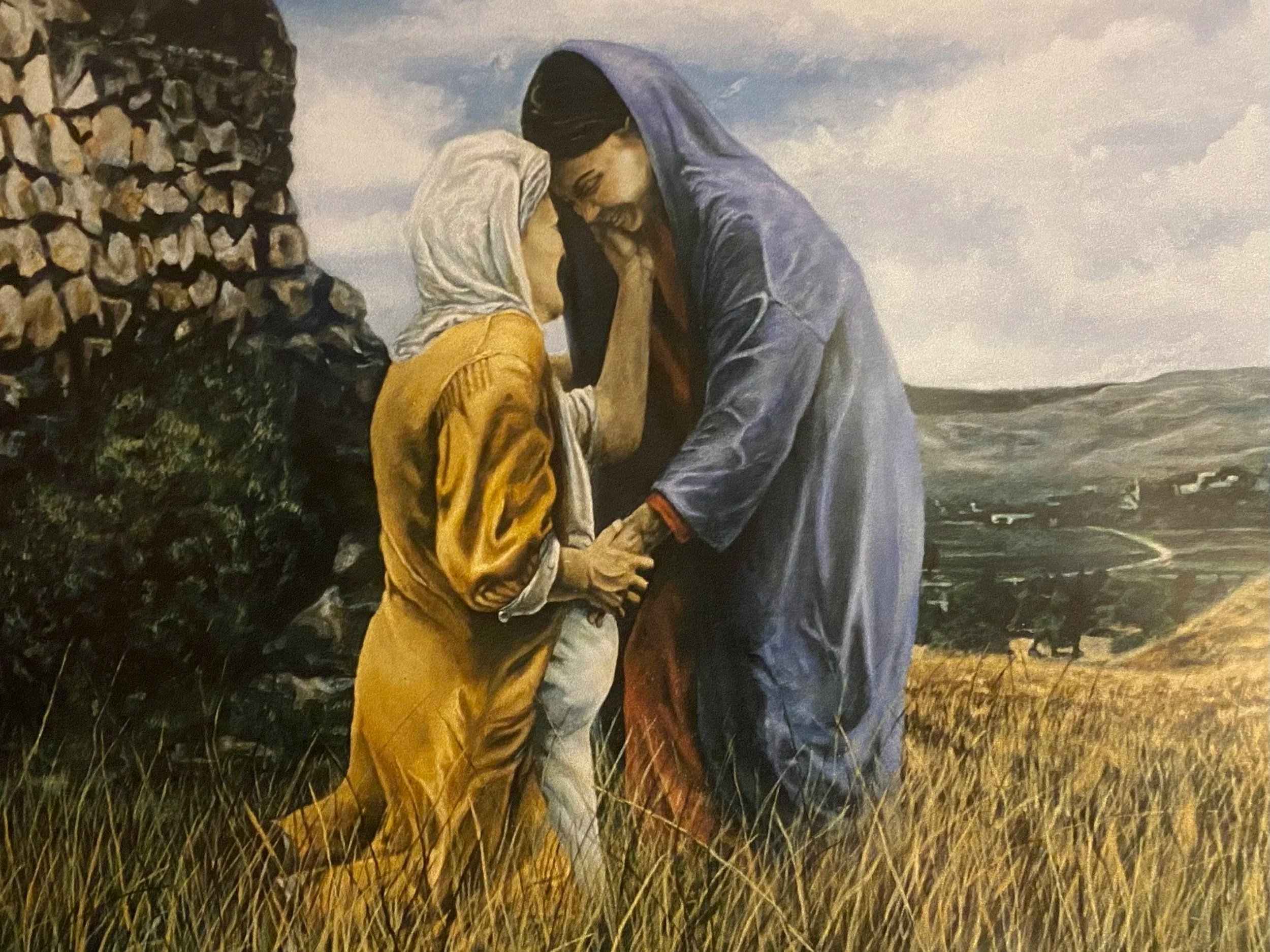
’Tis the season to sit with two of my favorite women in Scripture: Mary and Elizabeth.
What is it about these two that so captures me?
Certainly the contrast in the dramatic meeting of these two women is stark and captivating.
One barely a teenager, while the other is in her twilight years.
One was from a poor, religious family in a tiny insignificant town, the other, most likely was living middle to upper class comfortable life as the wife of a priest.
One was a young girl, on the cusp of beginning her life, and the other at the end of her life having tasted lifetime of dreams unfulfilled.
And their paths collide in an extraordinary moment where they are invited to gestate a God seed… literally. To carry within their very bodies, the two men who became central to God’s plan for humankind.
The fate of humanity hung in the balance on the response of this young teenager. In a moment of profound surrender, Mary says,
“I am willing to be used of the Lord.
Let it happen to me as you have said.”
Make no mistake, the YES of Mary was the most significant surrender in history, apart from Jesus yielding His life on the cross.
And then there’s Elizabeth. She, too, is invited to ‘yes’ to an extraordinary invitation, to bear a child in her old age, the forerunner of Christ prophesied about centuries earlier.
Surrender to an unfolding plan was probably not foreign to this devout couple. Elizabeth had surely said yes to God many times over, holding expectations of where that yes would lead. But the truth is, some of those ‘yes’s’ didn’t turn out like she expected.
Maybe as a young girl like Mary, she had mapped out a “Plan A” for her life: marry, become the wife of a priest, bear children, and enjoy grandchildren. But Plan A was long gone, and her earlier surrenders didn’t really lead where she thought they would.
Just how did Elizabeth navigate the disappointments of her life story?
Did she beg God? Did she bargain with God? Did she rant in frustration? Did she grieve and somehow keep soft-hearted towards God and others? Did others marvel at her ability to love God despite his deaf ears to her cries?
We don’t really know, but I’m pretty sure the woman who bore the John, the forerunner of Christ, was a woman of deep strength and faith. And like many saints before and since, her prayers were probably a mixture of frustration and faith, grief and gratitude, supplication and surrender.
So Elizabeth is invited to say yes again, from a very different place and season in her life. She is presented with Plan G (a God-plan), a brilliant and miraculous plan to become the mother of John the Baptist as an elderly woman.
And she does!
Imagine a woman in her 60’s or 70’s adding pregnancy symptoms onto her already long list of aging aches and pains. She nursed that child not with a young, supple body, but with wrinkles and sagging parts. And while she probably savored this late life gift of holding a son in her arms, church tradition indicates that both Elizabeth and her husband died when John was a child. She never did get to see him life into adulthood.
So what does this have to do with mid-life?
The yes’s we say in the second half of life are very different to the yes’s of our youth. Age and experience have taught us that our interpretation of God’s plan is not always on target. We know ourselves and the world better. We tend to count the cost more carefully. There is a lot less naivety in our surrender. But the good news is that we also know God differently. Some of our yes’s have yielded extraordinary fruit in our lives and the world around us.
In retrospect, we may have received glimpses that in fact, Plan A, might not have been best for us. And we’ve watched Him weave some heartbreaking losses into a beautiful redemptive story.
Every plan holds distinct beauty and pain.
Some invitations will bring joy, life, and fulfillment. We get to embrace the beauty of the fruits of our years and experience by…
Tasting the rewards of our hard work from the first half of life.
Giving from our abundance — materially or spiritually.
Savoring the beautiful people in our lives.
Welcoming the next generation and pouring love into them.
But in other places in our lives, we are invited to surrender to a plan we would not necessarily choose, such as:
Caretaking for an elderly parent or spouse
Starting over in a new place
Releasing an adult child to decisions that
Grieving the loss of a friend, spouse, or child
Navigating financial stresses while others do not
Facing your later years alone
Spiritual vitality in the second half of life is, in fact, deeply connected to our yes’s and no’s.
As we age, the temptation to choose for comfort, ease, and indulgence rears its head at nearly every juncture. We can easily feel entitled or tired or ready to let the next generation take over. We end up saying a lot of “NO’s” that just sound too costly to our routine and preferences.
Last year a couple I know took in a friend who was struggling to find work. What began as a week turned into almost a year. These two introverts said YES to the opening their home to a guest. Was it inconvenient and costly? Yes. But was it good for them (and her)? Yes!
Of course, many of the situations we face in later life, we have no control over. We may not get to choose whether we have to work longer than our peers, face our later years as a single, or navigate a cancer diagnosis.
Our YES often involves the difficult surrender of going inward to do the hard work in order to end well emotionally, relationally, and spiritually.
Will we become bitter, lashing out?
Will we forgive the person who has hurt us so deeply?
Will be becoming complainers about the world, our changing field, or ‘this generation’?
We will nurture resentment towards those who have it better than we do?
Will we wrestle through our disappointments with God or the church?
The truth is, as we age, our surrender is designed to become less focused on the situation at hand, and more focused on finding God Himself. We begin saying YES to having more of God in every part of our lives— the beautiful and the difficult parts.
We say YES to His companionship in the dark valleys. We say YES to the reassurances of His love as we begin to lose external places of affirmation. We say YES His comfort when we are scared or grieving.
And may we be like these two beautiful women—- saying yes from our earliest years, all the way until our final days.